Stitching a Story
A 17th-century mantua took shape at Plimoth Patuxet, expanding the story of Plymouth Colony into the 1670s. Through the later life of Pilgrim Elizabeth Warren, the garment illuminates the complexities of her world and a changing Colony.
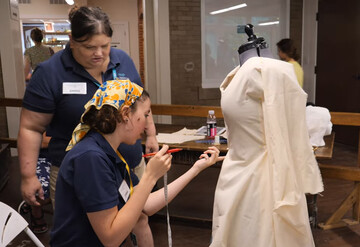
In 2024, the Historical Clothing & Textiles Department at Plimoth Patuxet Museums undertook a remarkable hands-on project: the creation of two 17th-century mantua mock ups alongside summer intern Emma Stewart. More than a garment, the mantua represents an expansion of the Museum’s storytelling, moving beyond the 1620s and into the 1670s. For our guests, this means they will soon encounter the world of Pilgrim Elizabeth Warren in her later years as a widow, landowner, and respected figure in Plymouth Colony during a time when New England’s political and cultural landscape was becoming increasingly complex. Warren’s story illuminates a period when tensions between English colonists and Indigenous Peoples were intensifying in the years leading up to King Philip’s War.
Within this shifting world, women like Warren navigated economic responsibility, property ownership, and community leadership. Clothing offers a powerful lens through which to understand their lives. Garments were among the most valuable possessions a woman owned—so valuable they frequently appeared in wills and estate inventories. A mantua, in particular, signaled status, skill, and access to global trade networks that supplied fine fabrics to the colonies. These garments were rarely static; they were altered, re-cut, and re-styled over decades to reflect changing fashions and the evolving circumstances of a woman’s life.
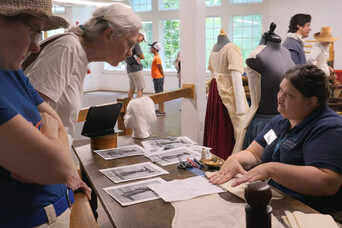
This history of adaptation makes the mantua constructed in 2024 especially meaningful. Its careful construction reflects not only 17th-century tailoring practices, but also the lived reality of women whose clothing evolved alongside their lives. Even more significantly, the mantua was researched, cut, and stitched in view of Museum guests. As visitors observed the work taking shape, they were invited into the process of historical interpretation itself — witnessing how material culture helps us reconstruct the lived experiences of women like Elizabeth Warren. This project not only deepens our understanding of the later 17th century, it also expands the immersive experience Plimoth Patuxet Museums offers. Bringing the complexities of colonial life after the 1620s into sharper focus — and illuminating the women whose stories shaped it — strengthens our collective understanding of Plymouth Colony and its enduring legacy.
Plimoth Patuxet Museums plans to break ground on the Warren House later this year. To learn more about the project or to make a philanthropic investment in this next chapter of storytelling, please click here. Through projects like this mantua, we are reminded that history is not only shaped by events, but by individuals — and that the stories of women like Elizabeth Warren continue to speak to us across centuries.
More about the Mantua
The mantua was a fashionable gown for the wealthy that originated in France in the 1670s and quickly spread to England and then to America. It evolved from the loose, robe-like garments worn in earlier years, which themselves were influenced by a range of Asian fashions.
Most surviving mantuas, or depictions of them in artwork, belong to wealthy women. However, the team at Plimoth Patuxet discovered illustrations in Marcellus Laroon’s Cries of London (1688) showing female street sellers wearing a simpler style of gown. These simpler gowns shared key design and construction features with the mantua, suggesting its influence extended beyond elite circles.
The 17th century also saw significant changes in women’s roles in trade. Whereas women had previously performed unskilled labor for low pay, widows like Elizabeth Warren were able to take over their husbands’ businesses, allowing them to participate in guilds and be treated equally to male members.
The mantua itself evolved alongside the lives of women. In 1675, King Louis XIV approved the establishment of the first seamstresses’ guild in France. Several factors contributed to the mantua’s role in this clothing revolution: it developed from garments intended for the private household sphere; it required close contact between client and maker while being draped directly on the body, rather than being patterned flat on a table; and it was largely ignored by male tailors, who considered it a passing fad.
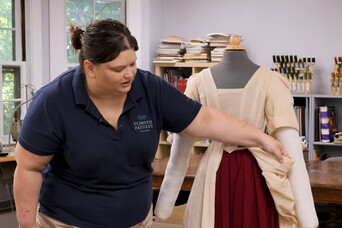
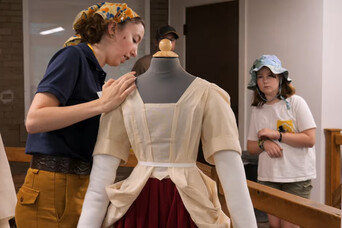
To study the mantua, Plimoth Patuxet’s team began with a muslin mock-up of the wealthy version, combining features from three extant gowns: a late 17th-century mantua from The MET (patterned in The Cut of Women’s Clothing), the Shrewsbury/Clive House mantua (1708–09, patterned in Patterns of Fashion), and a pre-1700 dress from Valdemars Castle. Insights gained from this wealthy mantua mock-up then informed the creation of a working-woman’s version, which required much more experimentation and trial-and-error.